| daily updates | dates and logistics | materials | support the tour | contact us | press room |
Los Angeles Times
COMMENTARY
March 5, 2004
Human Rights Are Dying on the Vine
By Eric Schlosser
Migrant farmworkers have long been among the poorest workers in the United States. The typical migrant is a 29-year-old Mexican-born male whose annual income is less than $7,500. He is likely to be here illegally, especially if he is among the poorest of the poor, those who pick fruits and vegetables by hand. And he is ripe for exploitation.
In California — where over the last two decades some farm wages, adjusted for inflation, have declined by about 50% — this is a familiar tale. But in the fields of Florida, wages and working conditions are even worse.
To earn the federal minimum wage picking tomatoes in southern Florida, a migrant has to pick more than 320 pounds an hour. That's more than a ton in an eight-hour day. In the fields near Immokalee, Fla., where much of the state's tomato industry is situated, a new form of indentured servitude flourishes. Illegal immigrants have been forced to work for below minimum wage to pay off their debts to people-smugglers and labor contractors. Since the mid-1990s the Justice Department has successfully prosecuted five cases of slavery in the region. The close relationship between Florida Gov. Jeb Bush and that state's agricultural interests guarantees that little will be done at the state level to remedy the situation. And that is why a growing national movement insists that the multinational corporations that buy Florida's produce must take responsibility for how migrant workers are being treated.
In 1999, the Coalition of Immokalee Workers, an organization devoted to helping migrants, learned that Taco Bell, headquartered in Irvine, Calif., was a major purchaser of tomatoes from Florida growers. The coalition asked the fast-food company to pressure its suppliers to raise wages and protect farmworkers from abuse. When Taco Bell failed to respond, the coalition launched a nationwide boycott of the chain in April 2001. Can Taco Bell guarantee, the group asks, that its tomatoes are not being harvested with slave labor? That question has yet to be answered.
Taco Bell is not the only corporation buying tomatoes from Immokalee growers. But it deserves to be a focus of attention when it comes to labor policies. In Oregon, Washington and California, Taco Bell has paid more than $17 million to settle lawsuits charging systematic violations of federal labor law. Moreover, its parent company, Yum Brands, which also owns Pizza Hut and KFC, operates more than 30,000 restaurants controlling a centralized purchasing system that has enormous power over food suppliers. And Taco Bell sells more Mexican food than any other company in the United States. It shouldn't profit from the exploitation of poor Mexican farmworkers.
After years of denying responsibility for the employment practices of its suppliers, Taco Bell recently posted a code of conduct on its website, stressing that all of the chain's suppliers should obey the nation's labor laws and that none should "produce goods … using labor under any form of indentured servitude."
The vow is admirable. But Taco Bell has not created a mechanism for monitoring or enforcing the new rule. Its suppliers audit themselves. Compare that to Taco Bell's animal welfare policy: "We are monitoring our suppliers on an ongoing basis to determine whether our suppliers are using humane procedures for caring for and handling animals they supply to us." Suppliers that mistreat animals can't do business with Taco Bell. The company must now show the same level of concern for the humane treatment of human beings.
The goal of the boycott is a wage increase of one penny for every pound that a migrant picks. That would leave wages lower than they were 25 years ago but would help farmworkers enormously. It would scarcely affect the price of a burrito.
And despite the protests of Florida growers, it wouldn't lower their profits much either. In 2002, the Florida Tomato Growers Exchange imposed a one-penny-per-pound surcharge to cover the rising cost of a soil fumigant, an increase that had little effect on tomato sales. "I guess [buyers] knew they didn't have much choice anyway," one grower told an industry trade journal.
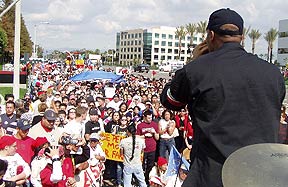
Today, a rally on behalf of the boycott will be held at noon in front of Taco Bell's corporate headquarters in Irvine, to deliver a clear message that until the company pressures its suppliers to treat migrants decently, nobody should buy a meal at Taco Bell.
The boycott has been endorsed by student groups, organized labor and the National Council of Churches. In November 2003, three members of the coalition received the Robert F. Kennedy Human Rights Award, the first time it has been given to people fighting human rights abuses within the United States.
The campaign against Taco Bell is just the beginning. When the company finally does the right thing, it will be time to focus on the labor policies of the other major fast-food chains. Until then a great deal of pointless misery will go into the making of your Happy Meals and Gordita Supremes.
------------------------------------------------------------------------
Eric Schlosser is the author of "Fast Food Nation" (Houghton Mifflin, 2001) and the collection "Reefer Madness" (Mariner, 2004), which includes an investigation of California migrant labor.